As the world recovers from COVID-19, we are trying to return to a new “normal”. On our way to this normalcy, we have been offered an opportunity to reflect on our actions and consider how we can be more resilient to such shocks, from pandemics to climate change.
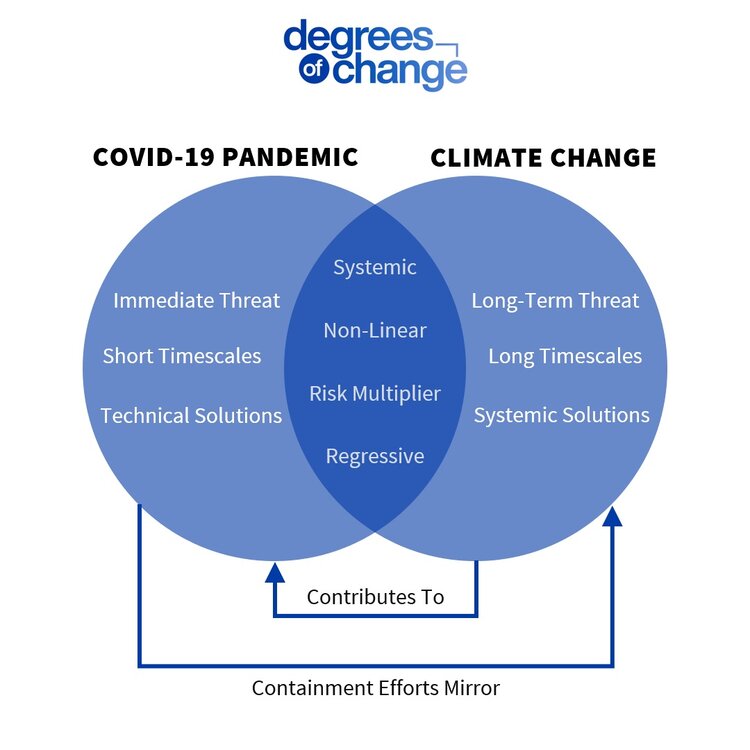
Although COVID-19 and climate change are two vastly different shocks, it is impossible to ignore that investing to adapt is an environmental, social, and economic opportunity.
From governments downplaying early warnings of an outbreak, to citizens protesting safety measures put in place, the reactions paid no heed to the words of caution put forth after elaborate modelling and analysis by experts.
We can learn from this to better prepare for future crises by shifting from a reactive stance, to a proactive one. Preparedness is not the by-product of an efficient system – it is the conscious design choice of one.
Almost seven in ten think climate change is “a very, or extremely serious, problem”, but the results show notable country differences.
Lack of concern is far higher in the US (12%) as well as in Sweden (9%), Greta Thunberg’s home country. Despite disastrous bush fires at the time of our fieldwork, 8% of respondents in Australia report that climate change is not serious at all.
Perhaps surprisingly, the five countries with the lowest levels of concern are all in Western Europe. In Belgium, Denmark, Sweden, Norway and the Netherlands, only around half (or less) think that climate change is a serious problem.
We also find a similar divide in Sweden. As Sweden is widely considered one of the world’s most progressive nations.
How society is affected by the corona virus can cause concern. We at the environmental company Ragn-Sells have contingency plans to keep the business running as far as possible if employees get sick or have to stay home.
Nitrogen, phosphorus and potassium are three essential nutrients for agricultural crop production. Phosphorous and potassium are finite resources found in only a few countries. Nitrogen, while ubiquitous in air, requires large amounts of hydrogen and energy to produce ammonia, the form of nitrogen that is used in fertilizer.
Ragn-Sells has built the first factory that will mine nutrients from power plants that burn waste and produce fly ash. The ash contains valuable potassium that can be mined and used in fertilizers.
In addition, Ragn-Sells has developed technologies to recover phosphorus from incinerated sewage sludge and to remove nitrogen from wastewater. Such “urban mining” of these three essential nutrients can prevent nutrient pollution in lakes and marine habitats, improve energy and resource efficiency, reduce greenhouse gas emissions and reduce costs. Both the phosphorus and the nitrogen cycle are also two of the planetary boundaries we have already started to exceed.